
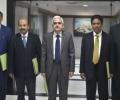
Nirmala Sitharaman on Wednesday assumed charge as the Finance and Corporate Affairs Minister for the second consecutive term and is slated to soon present the final Budget for FY '25 that is going to set the tone for the Modi 3.0 government's priorities and direction for Viksit Bharat. Upon her reaching the North Block office, Sitharaman was greeted by Finance Secretary T V Somanathan and other top officials. Minister of State for Finance Pankaj Chaudhary was also present. Chaudhary assumed charge on Tuesday evening.

Hopes of revival and earnings growth in 2020, surprise tax cuts, and robust foreign flows - thanks to easy global monetary policies - are a few reasons why the markets have managed to digest the low GDP footprint. Select bluechips such as Reliance Industries, Bajaj Finance, Asian Paints, and ICICI Bank have gained sharply this year. On the other hand, YES Bank, Zee Entertainment, and Indiabulls Housing have seen a sharp fall.

Gold prices tumbled by Rs 3,350 to Rs 72,300 per 10 grams in the local market in New Delhi on Tuesday amid subdued demand by jewellers after the government announced the customs duty cut on the yellow metal and silver to 6 per cent.

Stating that an economic recession gripped global economy following the lockdowns due to COVID-19 pandemic, Fitch Ratings on Friday said the initial disruptions to regional manufacturing supply chains in China have now broadened to include local discretionary spending and exports.

After a contraction in the current financial year, India's economy is forecast to bounce back with a sharp growth rate of 9.5 per cent next year provided it avoids further deterioration in financial sector health, Fitch Ratings said on Wednesday. The coronavirus pandemic will lead to shrinking of the already slowing economy in 2020-21 that started in April. Fitch Ratings forecast a 5 per cent contraction in the GDP in the ongoing financial year.

'We expect the bull-market phase to still persist, but now led by large-caps which offer better valuation and benefit from FII inflows.'
'We expect continued pressure on midcaps, but any sharp correction looks unlikely from here on.'

The revision of the consumer price index and GDP base years from 2011-12 and 2012, respectively, were dependent on the outcomes of the consumer expenditure survey of 2017-18 that the government decided to junk recently.

'Alongside economic growth and the Asian century, stress has become an Asian caravan.' 'But stress doesn't arrive in one's country as invitation to taste exhaustion. It comes dressed as a challenge.' 'Its evangelists ask: Are you man enough to shoulder stress?' points out Shyam G Menon.
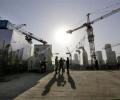
UPA-II has yielded a 7.5 per cent average annual growth rate
Sitharaman's Budget missed deficit target for the third year in a row, pushing shortfall to 3.8 per cent of GDP in the current fiscal as compared to 3.3 per cent previously planned.

'The Indian government is better prepared this time and has reached out to all contenders and not putting all eggs in one basket.'

Welcoming the latest round of stimulus announced by Finance Minister Nirmala Sitharaman on Thursday, experts said the measures will support the economic recovery boosting demand, job creation and by providing funds to the MSME and stressed sectors. The fiscal impact of the stimulus is likely to be around 0.25-0.6 per cent of GDP in the current fiscal, they said.

'As we expect the economy to continue to grow above the trend line, we expect capex decisions to be taken next year when there is more certainty about the cost of funding and the economy.'

While India should be concerned about disparities, the fact is that whereas three decades ago about half the people had incomes greater than $2.15 a day, today seven out of eight do, notes T N Ninan.

Finance Minister Nirmala Sitharaman on Tuesday met IMF managing director Kristalina Georgieva and discussed a range of issues, including impact of geopolitical situation on global growth.
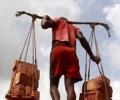
Brokerage firm Ambit Capital has cut FY17 growth estimate to 3.5 per cent from 6.8 per cent and saaid there was even a possibility of growth contracting during the December quarter

Following are comments from economists at leading financial institutions, banks and rating agencies on the interim Budget:
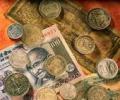
The chambers said that the situation calls for urgent policy measures both by RBI and the government to salvage industry from further decline in industrial output.
If this turns into reality, India's gross domestic product (GDP) growth will be the lowest since 2012-13, which could severely hit job creation and income growth in the near term.

India's GDP may turn positive at 1.3 per cent in the third quarter of 2020-21, having witnessed contraction in the previous two quarters due to the coronavirus pandemic, as the number of cases is falling and public spending has started rising, according to a report. The government will release the GDP numbers for the October-December quarter of the current fiscal on Friday. Projecting that the gross domestic product (GDP) may have returned to the black in the last quarter of the calendar year 2020, DBS Bank in the report said the full-year growth in real terms may be at a negative 6.8 per cent.

Industry body CII on Thursday made a case for pushing reforms in sectors like land, labour, and agriculture by the Modi 3.0 government to accelerate economic growth, which is estimated to be around 8 per cent in the current financial year. CII president Sanjiv Puri said a lot of policy interventions in the past have put the economy on "a much stronger wicket". "The growth rate is poised to touch 8 per cent during the current year, marking the fourth consecutive year of above 7 per cent + growth.
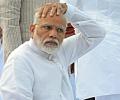
Moody's Investors Service on Friday slashed its estimate of India's GDP growth during the 2020 calendar year to 2.5 per cent from an earlier estimate of 5.3 per cent, on account of the rising economic cost of the coronavirus pandemic.
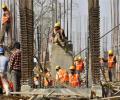
The EIU said in a report on Wednesday forecast that the real GDP grew by 1.6 per cent quarter-on-quarter in India, but noted that this uptick was largely owing to base effect.

Prime Minister Narendra Modi led-NDA government in its third term must tackle the problem of unemployment in the country, especially in the unorganised sector and in small and medium enterprises, former NITI Aayog Vice Chairman Rajiv Kumar said on Monday. Kumar also emphasised that the government now must finalise the four labour codes as it has been delayed beyond expectations. "We must recognise that post-COVID economic recovery has been a K-shaped recovery.
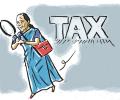
While the ratio determines the extent to which the government is able to finance its expenditure, it is also an indicator of tax compliance. Developed countries have a higher contribution of tax to their GDP.

Asked when the economy will revive, Das said it is difficult to make an estimate as there are many things which are still playing out.
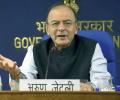
The FM said an announcement with regard to the additional steps will be made after consulting Prime Minister Narendra Modi.

There is a vocal constituency of educated, well-to-do, articulate Indian elites who would rather go with the idea that too much democracy is a liability. That India needs a spell of benevolent dictatorship. Of course, they have never lived under one, points out Shekhar Gupta.
GDP growth of 7.7 per cent in the first half of this fiscal has "left sceptics gasping and woefully behind the curve", an RBI article said on Wednesday. It also stressed the buildup in the growth momentum is likely to be sustained. The article on the state of the economy published in the Reserve Bank's December Bulletin on Wednesday also said CPI-based retail inflation is expected to ease to 4.6 per cent in the first three quarters of 2024-25 from 5.6 per cent in November.

More than 80 per cent of Indians live in districts vulnerable to climate risks. Among these, Assam, Andhra Pradesh, Maharashtra, Karnataka, and Bihar are the most vulnerable states to extreme climate events.
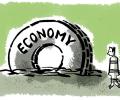
As he projected a grim outlook for the economy, RBI Governor said that amidst this encircling gloom, agriculture and allied activities have provided a beacon of hope on the back of an increase of 3.7 per cent in foodgrains production to a new record.

For 2020 calendar year, it reduced the estimate by a similar measure to 6.7 per cent.

Moody's Investors Service on Thursday said India is likely continue to face challenges in raising longer-term growth potential and creating enough jobs for its young population in the absence of higher trade openness. In its report on South Asia sovereigns, Moody's said compared with other South Asian economies, India appears to be in a better position to deepen its integration in global value chains, attract FDI and increase exports. The country has better macroeconomic fundamentals, more stable politics and a more developed export sector.

The slowdown is especially pronounced in rural areas, which have suffered two consecutive dry years.

The International Monetary Fund has reduced India's contribution to world gross domestic product in purchasing power parity terms to 4.6 per cent in 2007 from the earlier estimate of 6.4 per cent.
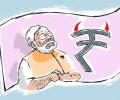
It is a classic case of extremes: The worst contraction in GDP along with the highest-ever levels of cash in the economy; and a severe dent in consumption together with strong growth in bank deposits and digital payments.

For the current fiscal which ends on March 31, it put the real GDP estimate at 5 per cent. It estimated a 7 per cent growth in 2022-23 and 2023-24 fiscal years. The inflation rate was seen moderating to 4.4 per cent in the next fiscal from 4.7 per cent in the current.

Rajan had said that there was lack of clarity about the new method.

India grew at 7.6% in 2015-16 and at 7.2% in 2014-15.
Rating firm Crisil revised downwards its GDP growth forecast to 5.5 per cent this fiscal from its earlier estimate of 6 per cent, citing reduced likelihood of monetary easing going forward due to falling rupee.
 © 2026 Rediff.com - Advertise with us - Disclaimer - Privacy Policy - Sitemap - Feedback - About us - Terms of use - Grievances